
Outline:
A Film Born from History and Resilience
Annemarie Jacir has been thinking about the idea for Palestine 36 for a long time. “My father was born in 1936,” she says, “and I’ve been hearing about the revolt of ’36 for years and years… because it’s such a critical one in our history.” Growing up in Bethlehem, Jacir recalls having relatives who spoke perfect British English, a remnant of Palestine’s colonial rule during the Mandate period. Many of those relatives have passed away, but their stories of the 1936-39 Arab revolt remained in her memory.
“That’s a very sort of abstract, early way of how it came up for me,” she explains. “Then I started to read more and more about it. I just kept discovering so much that surprised me,” and those discoveries eventually became Palestine 36, which has been shortlisted for the Best International Feature prize at this year’s Academy Awards.
Among the discoveries Jacir made during her research was the massacre of a village that took place in 1938. “We always talk about 1948, but 10 years before that, there’s this massacre by British soldiers,” which became part of “the Palestinian oral history.” These details found their way into Jacir’s screenplay, which was informed by “the whole system of military occupation that I live today.” The roots of that system, she explains, “go back to that period. Whether it’s the legal system in courts, whether it’s torture in prisons, collective punishment, the wall, it all stems from the blueprint of military occupation.”
Jacir spent years combing through archives, finding hours of newsreel footage. “The British were great at filming everything,” she says, as they documented information about their various colonies. “That archive is so precious, because some of it is the most mundane activities: people farming, people playing games, people playing tennis, people going for a walk. You see that lost world.” You also see “the violent part of it: checkpoints, blowing up houses, all the crimes of colonialism are also documented.”
There was a difficulty in watching this archival footage as well, as Jacir was often seeing “endless Palestinians being searched” by military police. “We’ve just always been made to feel like criminals.” This feeling made its way into the film in a scene where an elderly man has his books searched by the authorities. “That particular image really struck me,” Jacir reveals. “I come from a family of writers; my grandfather wrote until his final days.” A combination of her family history and the history of Palestine more broadly provided “the spark” for her film.
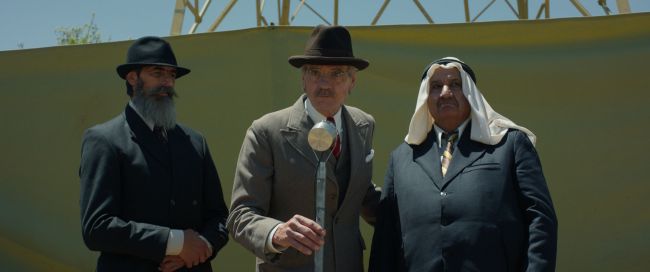
From the beginning, Jacir knew she wanted to craft an ensemble piece, and Palestine 36 features a wide variety of actors, including Hiam Abbass, Liam Cunningham, and Jeremy Irons. “It was never one or two characters,” she explains. “It was different storylines following different people, and how they interconnected with each other.” Although her film depicts history-altering events, Jacir wanted to focus on “the very small, mundane life of people, just ordinary people” who are affected by “our first mass uprising.”
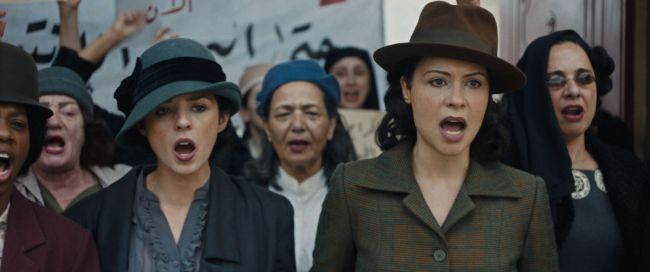
Jacir was interested in these characters, and the decisions they make at a certain point. “How does history, how does life, affect us as individuals?” Ultimately, Palestine 36 grapples with the question that crosses every revolutionary’s mind: “When do you decide to fight? When do you decide to do something?”
For Jacir, who directed the films Salt of This Sea, When I Saw You, and Wajib, Palestine 36 was “the most ambitious project any of us had ever worked on,” a fact she “chose to willingly ignore.” She went full-steam ahead with a massive historical epic despite not having adequate financing, let alone “a country that has support for cinema. We have an occupation that we deal with—we always make films around that—but we live here and we know our way around things, and we know how to make things happen when everyone tells you it’s not possible.”
Despite these limitations, Jacir and her team decided to “do everything that we think we can do, as if we were living in a place where you could just make films without [an] occupation.” She was being “willingly naive,” which gets to the heart of why she makes films in the first place. “You can be free when you make films,” she adds, “and you can imagine a different kind of world.”
Jacir was preparing to shoot in Palestine, “doing all kinds of crazy things” like location scouting, building villages, and constructing military equipment, all while being stopped and questioned by local authorities and settlers. Then the events of Oct. 7, 2023, happened, throwing the entire country into turmoil. “That was the big kick in the face,” Jacir admits. “We were already edgy with trying to make things happen, and then it became just impossible.”
With an ongoing genocide, Jacir wondered, “who cares about film? Who cares about cinema?” Ultimately, she realized, “we’ve got to keep going, because it’s a way to refuse all of this darkness. It’s a way to refuse being erased, and all this bleakness. It’s a way to say ‘no’ to that.”
Jacir and her team moved the production to Jordan because the locations they had scouted “were just gone… The village we had prepared was impossible to film in.” The production eventually moved back to Palestine, making it the only film to shoot in that country over the last two years. “I think we were all a little crazy making this,” Jacir admits, likening it to the famously difficult shoot of Apocalypse Now.“We were in this kind of zone where we were functioning in a way where I think it was the only thing we knew how to do. It was maybe a question of survival somehow.”
Recreating historical atrocities as current-day ones were occurring made for a tense shoot. “Different people had different ways of reacting, and some people had days where they were just in total despair,” Jacir recalls, admitting that she at times found herself feeling the same way. “Psychologically, emotionally, it was very difficult,” because “we were making something about this violence that existed 90 years ago, fully aware that we were shooting in a place where the violence that was really happening was 500 times worse than that.”
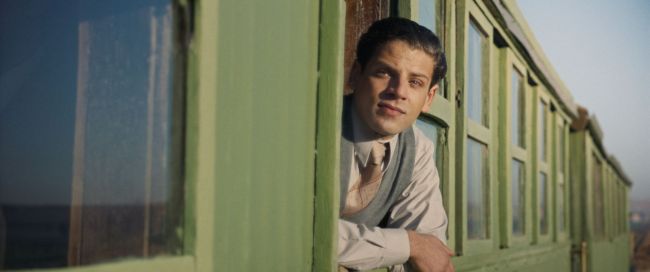
These feelings found their way into the performances, especially during the village massacre scene. Jacir remembers a moment when Yafa Bakri, who made her acting debut as Rabab, literally fainted when they were staging the arrival of the British Army. “She was so emotionally wrapped up,” Jacir explains. “For her, for the whole cast, it felt real.”
A film about Palestine made by Palestinians, Palestine 36 reflects “our point-of-view of this moment in history.” At the same time, Jacir believes the story is “very universal. Anyone who’s coming from any place that has a background of colonialism can relate to it. I hope that people see themselves in it. I think in the end it’s a very human, emotional story.” She hopes the film will encourage people to learn more about the real events, which is why she refused to include cards explaining that history to the viewers. “If you know, you know, and if you don’t, you can google it and find out. Do your research. It’s what I do when I watch films. I love to do that. I just want people to watch a story, and connect to it and relate to it. It’s a very intimate story about a group of villagers and this major moment in time.”