
Outline:
Two remarkable new photographs of the interstellar comet3I/ATLAS– one obtained from Earth using the Gemini North telescope in Hawaii, and another captured from deep space by NASA’s Europa Clipper spacecraft – have been made available to the public.
The comet captured international attention in 2025 after scientists verified its journey through our Solar System, having originated from a far-off star.
It is believed to be the earliest comet ever recorded – and one of just three interstellar entities ever identified within our Solar System.
The initial photograph was captured on November 26, 2025, utilizing the Gemini Multi-Object Spectrograph located on the Gemini North telescope, situated at the summit of Maunakea – a dormant volcano found on the Pacific island of Hawaii.

Since comets travel rapidly across the sky in comparison to distant stars, the telescope needed to follow the comet’s movement during extended exposures. This results in the background stars appearing as lines. The final picture has now been edited to eliminate this effect, ensuring the stars remain stationary.
NASA has also shared a picture of 3I/ATLAS taken by the Europa Clipper spacecraft, which was launched in October 2024 and is now en route to Jupiter.
The main objective of Europa Clipper is to investigate Europa, one of the biggest moons of Jupiter.
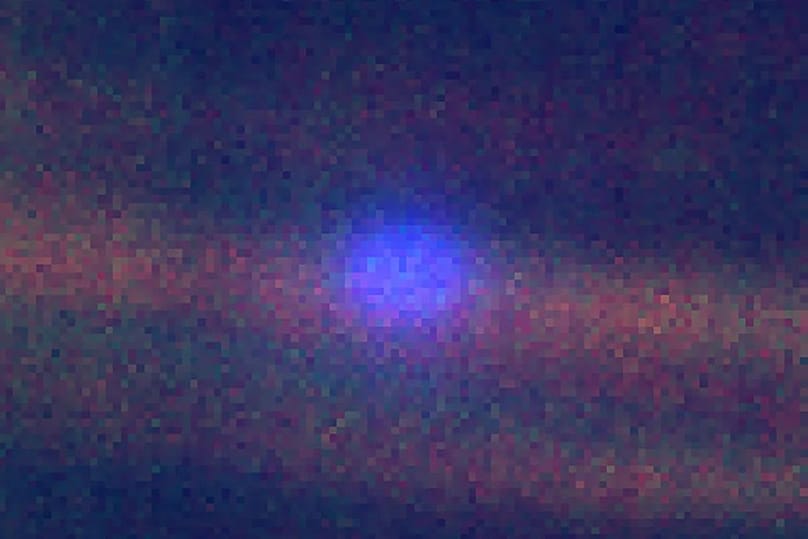
Even though the spacecraft is not expected to arrive at the Jupiter system until 2030, its equipment is already operational, enabling it to detect and record objects that pass by.
NASA researchers took this chance to direct Europa Clipper’s camera towards 3I/ATLAS, obtaining this special image of the comet from space as it traveled through the inner Solar System.
Utilizing various UV light wavelengths, the image displays the gas (blue and green) and dust (red) halo that encircles the comet’s core.
The Europa Clipper monitored 3I/ATLAS for approximately seven hours, at a distance of roughly 164 million kilometers.
A unique guest from outside our Solar System
Comet 3I/ATLAS was identified on July 1, 2025, and soon emerged as one of the most significant space science developments of the year.
In contrast to the majority of comets that develop within our Solar System, 3I/ATLAS came from much farther out.
Being the third confirmed interstellar object ever documented – following ʻOumuamua in 2017 and 2I/Borisov in 2019 – 3I/ATLAS drew interest due to its frozen center surrounded by a coma, the glowing cloud of gas and dust.
Since its identification, researchers have been hurriedly attempting to view the comet with some of the world’s most advanced telescopes, before it leaves the Solar System and vanishes from sight permanently.
The comet also triggered discussions about a possible moremysterious origin. Observations from the Atacama Large Millimeter Array (ALMA) revealed that it deviated slightly – four arcseconds from its expected trajectory – and its color changed significantly, from reddish to deep blue.
In a blog entry, Harvard astrophysicist Avi Loeb proposed that the anomaly could potentially signify “the technological signature of an internal engine,” although many scientists warned that natural explanations were much more probable.
To date, there is no solid proof to back the idea that 3I/ATLAS originated from aliens. In fact, recent attempts to detect signs of alien technology on 3I/ATLAS have not yielded any results.
On December 18, the day before 3I/ATLAS achieved itsclosest point to earth,Astronomers utilized the Green Bank Telescope located in West Virginia to examine the comet for “technosignatures,” which are detectable indicators of extraterrestrial technology. However, the world’s biggest fully adjustable radio telescope failed to discover anything significant.
Currently, 3I/ATLAS keeps moving through our celestial area in a short but impressive trip. As per NASA, its last major interaction will be a near pass by Jupiter in March 2026, after which it will depart our solar system permanently.