
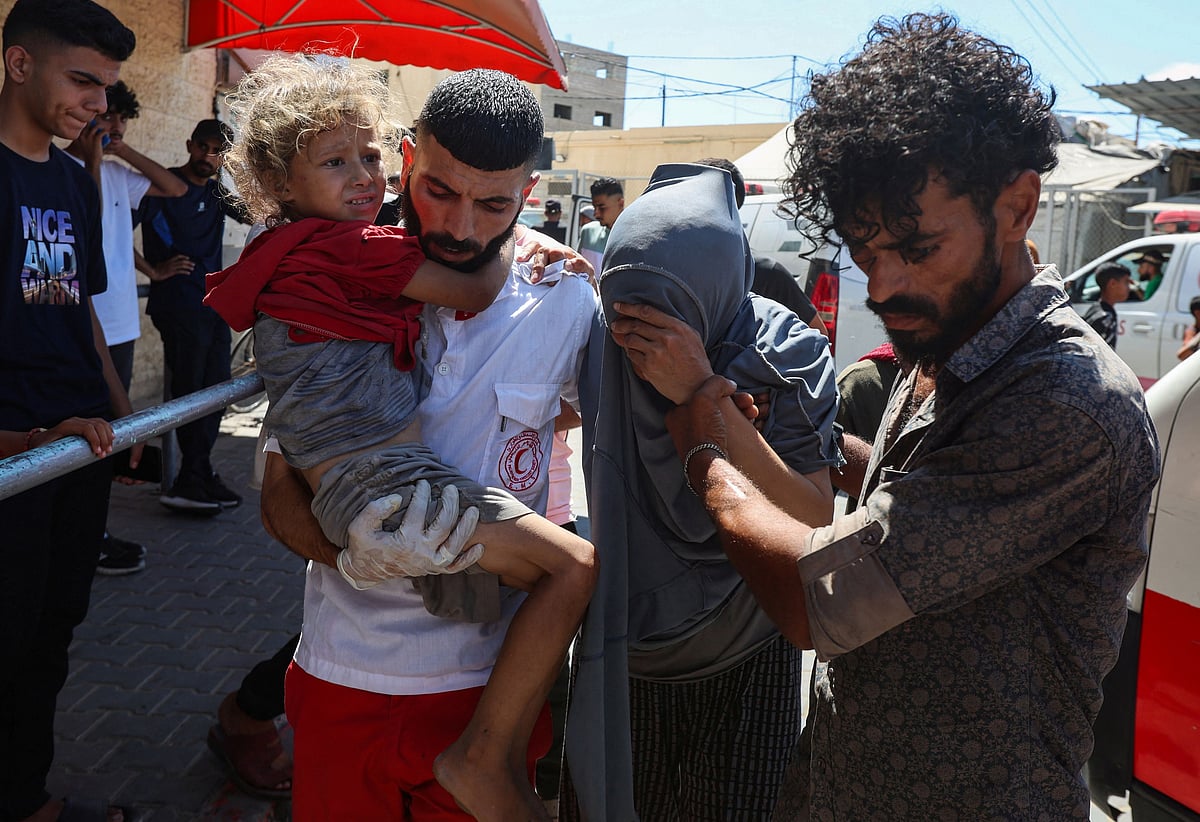
Every time Mansour Abu Al Khaier looks towards Gaza, the 45-year-old Palestinian man only witnesses death, devastation, and hunger following almost two years of conflict between Hamas fighters and Israel.
However, despite the destruction of Palestinian lives throughout the Israeli air strikes and intense shelling, Al Khaier and others strongly oppose US President Donald Trump’s plan, backed by Israel, which aims to relocate Gaza’s 2.3 million people.
“This is our homeland. To whom would we hand it over, and where would we go?” questioned Al Khair, a technician.
Trump, welcoming Israeli Prime Minister Benjamin Netanyahu to the White House on Monday, suggested advancements in a controversial plan aimed at moving Palestinians from the coastal area.
In a statement to journalists at the beginning of a dinner involving US and Israeli officials, Netanyahu mentioned that the United States and Israel are collaborating with other nations to provide Palestinians with a “more promising future,” implying that Gazans could relocate to nearby countries.
During a conversation with Trump, Netanyahu stated: “You understand that if individuals wish to remain, they have the right to do so. However, if they desire to depart, they should be allowed to leave. It shouldn’t function as a prison. It should be an open environment that offers people the freedom to choose.”
Prime Minister Netanyahu stated that Israel is collaborating with Washington to identify additional nations that would support such a proposal.
We are collaborating closely with the United States to identify nations that aim to fulfill their long-standing commitment to providing the Palestinians with a better future. I believe we are nearing the discovery of several such countries.
Five days following his inauguration in January, Trump stated that Jordan and Egypt should accommodate Palestinians from Gaza, indicating he was receptive to this as a potential long-term solution.
Cairo and Amman swiftly rejected Trump’s proposal to transform impoverished Gaza into the ‘Riviera of the Middle East,’ with Palestinians and human rights organizations also opposing the plan, stating it would equate to ethnic cleansing.
When questioned this week regarding the displacement of Palestinians, Trump mentioned that the nations surrounding Israel were offering assistance. “We have experienced strong collaboration from … neighboring countries. … So positive outcomes will occur,” Trump stated.
Saed, a 27-year-old from Gaza, was disturbed by the news that Trump and Netanyahu, whose armed forces have devastated large parts of Gaza, are once more considering the concept of relocation.
Despite over 20 months of conflict and multiple instances of internal displacement, he still feels a strong connection to Gaza, a small and heavily populated area that has housed generations of refugees who fled during the 1948 war which resulted in the establishment of Israel.
“We have the right to depart voluntarily and visit other nations, but we oppose the displacement plan as Palestinians,” stated Saed.
The Palestinian people have been striving for years to establish a sovereign nation in the territories under Israeli control, including the West Bank, Gaza, and East Jerusalem, via a peace initiative facilitated by the United States.
Fear of repeated ‘Nakba’
Numerous Palestinians blame Israel for systematically diminishing their chances of establishing a state by expanding construction in the West Bank and destroying large parts of Gaza in the ongoing conflict.
Israel denies the allegations, stating that it is solely targeting Palestinian fighters it claims present a critical threat, and that it has historical and biblical connections to the West Bank.
One of the most emotionally charged matters for Palestinians is the possibility of experiencing a recurrence of the 1948 ‘Nakba’ (disaster), during which hundreds of thousands lost their homes in the conflict that marked the establishment of Israel.
The catastrophe has been a significant event for Palestinians over the past 75 years, influencing their national identity and affecting their tense connection with Israel throughout the following decades.
For Israelis, the establishment of their nation was a joyful event for a community that had faced persecution for many years.
The conflict in Gaza began in October 2023 when Hamas launched an attack on southern Israel, resulting in the death of approximately 1,200 individuals and the capture of 251 hostages, as reported by Israeli sources. Around 50 captives are still in Gaza, with 20 thought to be alive.
The Israeli military’s latest attack on the Palestinian territory during its conflict with Hamas has resulted in more than 57,000 Palestinian deaths, as reported by the Gaza health authority.
According to research conducted by the Palestinian Center for Policy and Survey Research, some Palestinians who have endured continuous Israeli air strikes and significant shortages of food, fuel, medical supplies, and water are seeking an escape.
“Nearly half wish to depart from the Gaza Strip if given the opportunity,” stated the research institute in a report released in May.
A suggestion reviewed by Reuters and associated with a contentious US-supported relief organization outlined a strategy to establish extensive camps known as ‘Humanitarian Transit Areas’ within — and potentially beyond — Gaza to accommodate the Palestinian people.
It presented a plan for “overthrowing Hamas’ authority over the people in Gaza”.
According to Gaza-based Palestinian Abu Samir El Fakaawi, “I will not depart from Gaza. This is my homeland.”
He stated: “Our children who were killed during the conflict are laid to rest here. Our families. Our friends. Our cousins. We are all buried here. Regardless of whether Trump or Netanyahu or any other individual approves or not, we will remain on this land.”
Red Cross reports that the Gaza health system is struggling with the high number of injured individuals at aid distribution points.Gaza ceasefire negotiations restart with Trump expressing optimism about an agreement