
Outline:
It is regarded as one of the most significant milestones in the course of human development.
Currently, researchers think they have identified the time when our forebears shifted from walking on four limbs to standing on two legs.
An animal resembling an ape that existed in Africa seven million years ago is considered the leading candidate for the earliest ancestor of humans, according to new research showing its bones were suited for walking on two legs.
The remains of the species known as Sahelanthropus tchadensis were initially discovered in the desert area of Chad, located in central northern Africa, over two decades ago.
The structure of the skull indicated that it probably rested directly above the spine – the initial sign that it might have moved in an upright manner.
However, recent examination of the limbs indicates that the species was capable of moving on two legs, as the bones exhibit a characteristic unique to bipedal groups.
Scott Williams, a senior lecturer from the Department of Anthropology at New York University, headed the research.
‘Our examination of these fossils provides clear evidence that Sahelanthropus was capable of walking on two legs, indicating that bipedalism emerged early in our evolutionary history and originated from an ancestor that resembled modern-day chimpanzees and bonobos,’ he stated.
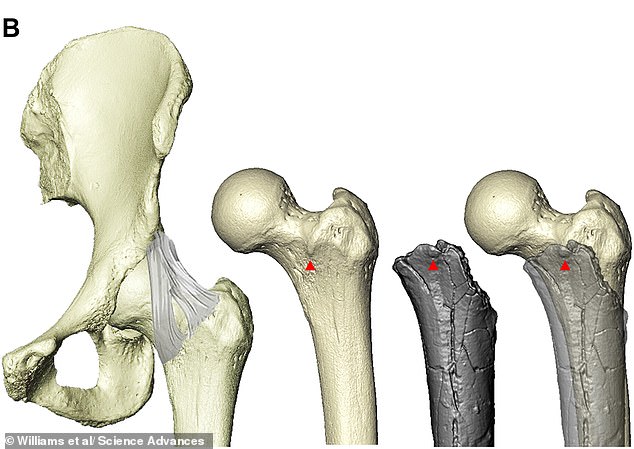
For their recent research, the scientists discovered the existence of the femoral tubercle, a body part essential for walking in an upright position, within the fossilized remains.
This is where the strongest and largest ligament in the human body – the iliofemoral ligament – is attached, linking the pelvis to the femur and limiting excessive backward bending of the body while standing and walking.
Earlier research has also discovered a ‘natural twist’ in the fossilized femur – the bone in the thigh – that enables the legs to face forward.
Meanwhile 3D analysis has indicated gluteal – buttock – muscles similar to those in our early ancestors that keep hips stable and aid in standing, walking and running.
The group claims their latest finding, combined with earlier results, suggests the ancient species was capable of walking on two legs.
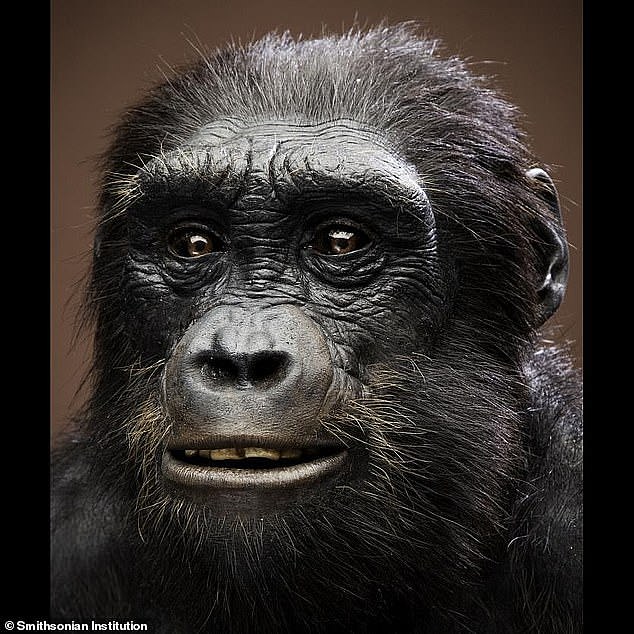
‘Sahelanthropus was primarily a bipedal ape with a brain similar in size to that of a chimpanzee and probably spent much of its time in trees, searching for food and protection,’ Dr Williams stated.
Although it may seem simple at first glance, Sahelanthropus was capable of walking on two legs and moving along the ground.
This finding identifies the species as the oldest recognized member of the human family tree since our evolutionary divergence from chimpanzees.

Humans and monkeys only separated approximately eight to 19 million years ago, indicating that early humans started walking on two legs shortly after this divergence.
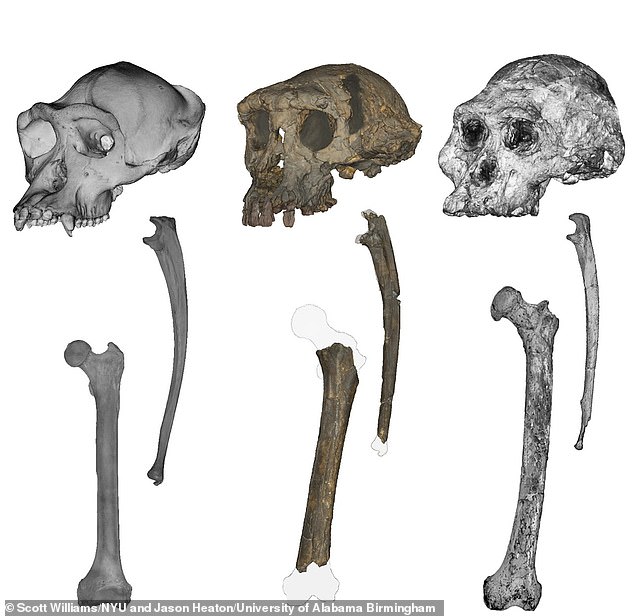
As part of the research, the group analyzed the remains in comparison with those of other early human predecessors and modern apes.
They discovered that Sahelanthropus possessed a significantly longer thigh bone compared to a bone located in the forearm – additional proof that it moved by walking on two legs.
They mentioned that apes possess long arms and short legs, whereas humans and our predecessors have comparatively longer legs.
Writing in the journal Science Advancesthey stated that bipedalism is considered a ‘critical feature’ which sets apart hominins – humans and our ancient relatives – from both current and extinct apes.
‘Sahelanthropus is viewed here as an African ape-like primitive human that shows some of the earliest signs of walking on two legs,’ they wrote.
They mentioned that they think the development of walking on two legs was a ‘process rather than an event,’ where bipedal movement slowly became more prevalent over time.
This indicates that the species might have been capable of walking on two legs on land, while also being able to move through trees like a monkey.
Several other specialists have previously questioned the notion that Sahelanthropus is an ancestor of humans.
In 2001, when the species was initially identified, Milford Wolpoff, an anthropology professor at the University of Michigan, raised doubts about them.
In a letter to the journal Nature, Professor Wolpoff argued that Sahelanthropus is ‘not on the line directly leading to humans’.
He indicated the marks on the skull caused by neck muscles, asserting they indicated the species moved on all fours with its head aligned with its spine.
Read more
- Have researchers uncovered a previously unknown human relative that is changing our understanding of evolution?
- Did early human species exhibit a wider range of walking methods compared to contemporary humans?
- Was the striking finding of Paranthropus capensis truly reshaping the narrative of human evolution?
- What unknown ancient human relative have researchers discovered in Colombia that might change our perception of evolutionary history?
- Could the 200,000-year-old Homo juluensis found in China change the story of early human evolution due to its large skulls and strong survival methods?